AI Tools Are Becoming the New Apprentice, Capturing Retiring Workers' Knowledge Before It Walks Out the Door
According to Construction Executive, the construction industry isn’t simply dealing with a labor shortage. It’s facing what the publication calls a “knowledge cliff,” a generational loss of on-the-job expertise that no recruiting campaign can fully address. The article, written by Brad Claus and published June 1, 2026, makes the case that artificial intelligence is beginning to fill the gap left by retiring foremen, operators, and technicians whose hard-won field knowledge has historically walked out the door with them.
For subcontractors running lean crews in the Permian, on Gulf Coast infrastructure projects, or across Bakken oilfield service routes, this argument lands close to home.
Background
Construction Executive reports that more than 40% of the construction workforce is approaching retirement age, a figure that sets the stage for the broader argument in the piece. The problem, Claus writes, isn’t just headcount. When experienced workers leave, they take with them the practical knowledge that can’t be captured in a training manual: the instinct built over decades of running equipment, diagnosing failures, and navigating jobsite conditions.
The article describes a shift in how apprenticeship itself is being reimagined. Traditionally, learning a trade depended on proximity, watching a veteran work and absorbing knowledge through repetition and mentorship. That model requires time, continuity, and the physical presence of someone willing to teach. All three are increasingly hard to guarantee on modern jobsites, where turnover is high, experienced workers are scarce, and project timelines leave little room for slow-burn mentorship.
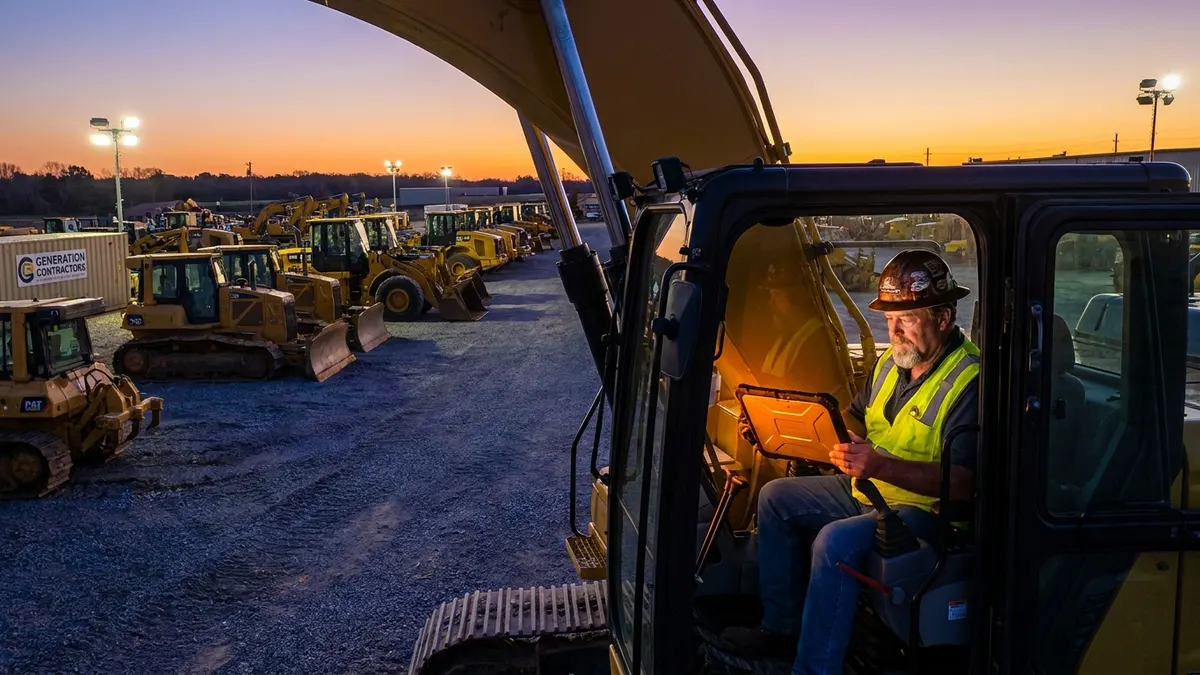
According to the piece, what’s emerging instead is a technology-assisted model where AI tools embedded directly in equipment and workflows can deliver guidance in real time, at the point of need, without requiring a senior technician to be standing nearby.
Claus highlights voice-activated interfaces and guided diagnostics as specific examples of this evolution. The article points to Bobcat as one company already moving in this direction, embedding intelligence into equipment to support operators in the field. The underlying logic is that when learning happens in context, at the machine, during actual work, it accelerates skill development in ways a classroom or even a traditional apprenticeship often can’t match.
The piece also notes that the knowledge cliff extends beyond equipment operators into maintenance and repair. Experienced technicians are retiring at the same time that equipment is becoming more technologically complex, a double squeeze that puts field service companies in a difficult position.
Analysis
The argument Construction Executive is making isn’t really about AI as a technology play. It’s about institutional memory, and what happens when companies fail to treat it as an asset worth preserving.
Field service companies in oil and gas and heavy construction have always depended on people who know things that aren’t written down anywhere. The experienced drilling fluids hand who can read a shaker. The equipment operator who knows exactly how a machine sounds before a hydraulic failure. The site supervisor who’s seen a particular formation condition before and knows how the ground behaves. This is the knowledge that doesn’t show up in a hire’s resume and can’t be taught in an onboarding session.
The “AI apprentice” model described in the article is essentially a mechanism for encoding some of that knowledge into the tools themselves, so that a newer worker operating a machine or diagnosing a problem gets the benefit of accumulated experience without requiring the veteran to be present. That’s a meaningful shift. It moves expertise from a person who will eventually leave to a system that persists.
For subcontractors, the practical implication is competitive. Companies that build these feedback loops now, capturing how their best people make decisions and embedding that into training tools or equipment interfaces, will have a structural advantage as the labor market tightens further. Those that don’t will face a recurring knowledge reset every time a key employee retires or leaves for a competitor.
There’s also a hiring angle. Younger workers entering the trades increasingly expect technology to be part of their work environment. AI-assisted tools that provide real-time guidance don’t just preserve institutional knowledge. They can also make a company’s training environment more attractive to recruits who want to build skills quickly.
The maintenance and repair dimension flagged in the article deserves particular attention for subcontractors running their own equipment fleets. Diagnostic AI that walks a less experienced technician through a repair procedure could reduce downtime and lower dependence on a shrinking pool of senior technicians, a real operational benefit in remote or fast-paced field environments.
What It Means for Subcontractors
- The labor shortage isn’t just about bodies. The bigger long-term risk for most field service companies is the loss of experienced judgment, and that requires a different response than recruitment alone.
- AI tools embedded in equipment and workflows are beginning to function as a scalable substitute for direct mentorship. Subcontractors should evaluate whether their current equipment purchases include these capabilities, and whether vendors like Bobcat are building in the kind of guided diagnostics described in the article.
- Field service companies with high turnover should treat knowledge capture as an operational priority, not a training department project. If your best people are within 10 years of retirement, the time to document and encode their expertise is now.
- Smaller subcontractors who can’t afford dedicated training programs may benefit most from AI-assisted tools, since the guidance travels with the equipment rather than requiring a dedicated instructor or training facility.
- Maintenance and repair is an underrated vulnerability. As equipment becomes more complex and experienced technicians become harder to retain, AI-assisted diagnostics could be a meaningful hedge against costly downtime in remote field environments.